
Jim Wells County Crime News Sources
Jim Wells County has no county-run daily crime bulletin. The local media scene is a patchwork instead. The best newspaper lead is the archived mirror of the Alice Echo-News Journal. It holds older Alice Police Blotter pieces, Sheriff items, and "JWC Top 10" features from past years. Treat it as a discovery archive, not a same-day feed. KRIS 6 and South Texas Community News report on events as they happen. Their stories can tie a city agency, an affidavit, or a transport to the county detention facility.
For custody facts, start with the Jim Wells County Jail page and its linked current roster. The official material says nothing about a same-day or weekly booking feed. It doesn't say how long entries stay visible either. Nor does it say whether photos appear at all. That gap matters. A current news report and an official roster link each answer a different question. Neither settles the outcome of a case by itself.
Jim Wells County News Outlet Coverage
Every outlet plays a different part here. Archives preserve the past. TV and community news cover selected events as they happen. The county's roster is a custody tool, not a media library. The table below keeps those roles apart and flags when a photo is merely a courtesy or agency-supplied image rather than part of a confirmed booking-photo policy.
| Outlet or source | Coverage | Photo context | Where |
|---|---|---|---|
| Alice Echo-News Journal archive | Historical Alice PD, Sheriff, and local crime items | Some historical stories may use agency or courtesy images | Archive mirror |
| KRIS 6 | Selected Jim Wells County stories | Story-level image credit may identify an agency source | Jim Wells example |
| South Texas Community News | Event-driven Premont and Alice reporting | May use a release or agency image when visible | Premont example |
| Jim Wells County Jail | Official-linked current-custody route | Public photo behavior was not verified | Official jail page |
Read every story with its date and its sources in mind. A piece that reports a booking and a later release can help you trace a sequence. Still, it will never give you a full jail log. A reporter quoting an affidavit is giving you a point-in-time account, nothing more. The next stop should always be the official custody or court path. Never the headline.
Jim Wells County Mugshots in Stories
News outlets often run photos credited to a sheriff's office or another agency when covering a case. That is not a promise from the county to publish every booking photograph. The official jail page links a current roster. But nothing on it confirms whether results show photos, booking cards, release flags, or any particular search fields. A picture in an article cannot answer those questions.
The captured view below shows the local-news context of a Premont report. It serves as a source reference only, not a gallery and not a claim about present custody.
South Texas Community News’ Premont arrest report
That report describes a Premont Police Department arrest and transport to the Jim Wells County Adult Detention Center. It's a good illustration of how an arrest moves from a city agency into the county jail. Current custody still belongs to the county roster. The court outcome belongs to the clerk.
Texas Business and Commerce Code Chapter 109 covers certain business practices involving criminal-record information, including arrest photographs. It does not make a press image into an official roster entry. Nor does it settle how a case ends. When facts change after publication, court records and the original custodian are still the places to turn.
Jim Wells County News Release Limits
No county policy spells out when a booking photograph goes to news outlets. None says when a roster result carries an image or how long a result stays posted. Texas public-information law opens a path to existing records. But it cannot force the county to build a media gallery. It can't promise that any given image is releasable either. Keep three things separate: the reporter's credited photo, the affidavit quoted in a story, and the county booking card. Each is its own record.
For any specific report, note the story date, the issuing agency, and the alleged event. Then ask the responsible custodian for the existing record. Check the court file for the disposition. That approach respects records that may be sealed, expunged, or otherwise off limits. It also keeps the selective images in media coverage from standing in for every county booking.
From Jim Wells News to Court Records
A local report is a start, not a finish line. Save the story URL. Note the reporting date, the named agency, and any booking date mentioned. Then trace the record through whichever system holds each phase. Keeping current custody, old coverage, and court action separate saves real confusion later.
- Start with the official Jail page and open its current-roster link to check for a current-custody record.
- If the person is no longer visible or the portal is unavailable, submit a focused request through the county Record Request Department for the identified booking record or photograph, if releasable.
- Use the 79th Judicial District Clerk or appropriate lower-court clerk to locate a cause number, docket, hearing, or disposition.
- Compare the court outcome with the early charge before drawing any conclusion. Charges can be changed, reduced, dismissed, or resolved in another way.
A booking entry in Jim Wells County shows who was arrested and when. News stories add detail that a roster alone can't give. To see how a case actually ended, look at the court record itself.
The county-wide booking, roster, and records path lays out the custody channels in more depth, including TDCJ, federal, and records-request distinctions. It helps when someone has been released, transferred, or simply does not appear in the current local interface.
Premont Crime News Is Not a Booking Count
Premont's public-safety page is a good example of why numbers need context. An April 2, 2025 update listed the city's 2024 figures: calls for service, traffic stops and vehicle contacts, offense reports, and business checks. Those numbers measure police work. They don't count bookings at the jail. They don't count mugshots either.
The difference matters anywhere in Jim Wells County. One police contact can ripple into several separate documents, from an incident report to a county booking to a magistrate hearing and a court file, and each sits with a different record holder. The South Texas Community News Premont report helps here, since it ties an arrest to transport at the county detention center. Even so, it can't turn an activity report into an arrest roster. Anyone after city-specific records should go through the local agency's records path and the county custody source instead of doing math on unrelated activity figures.
Note: A police contact, an offense report, and a booking may be connected, but they are separate records that cannot stand in for one another.
Jim Wells County Unofficial News Archives
Commercial sites with county sections can turn up booking material that looks recent or historical. Treat them as discovery aids only. Busted Newspaper, RecentlyBooked, Arrests.org, and Mugshots.zone all carry Jim Wells County pages. Entries can lag. They can run incomplete, match the wrong person, or linger long after someone has left county custody. None of these sites is run by the Sheriff. None should stand in for the county's current roster.
A saved copy of the RecentlyBooked Jim Wells County page shows why the label deserves caution. It is an unofficial publisher's view. It is not a documented county feed refreshed every 24 or 48 hours.
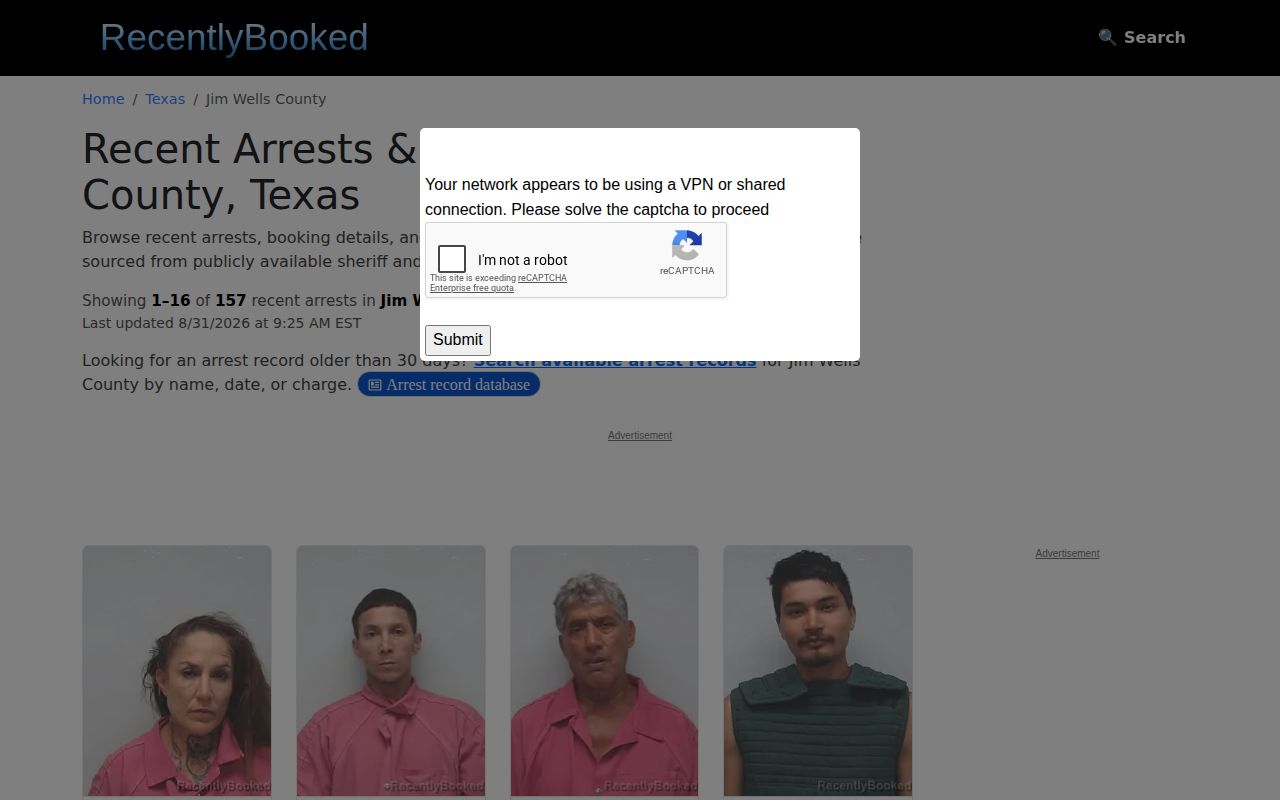
Treat a secondary page as a lead, nothing more. Use it to spot a name or a date worth confirming. Then check that name against the Sheriff's channel and the court docket. The extra step matters most when an entry looks stale, when no arresting agency is named, or when a story mentions a release.
Jim Wells County After a Crime Story
After a booking, watch for the local Article 15.17 hearing. A Texas Indigent Defense Commission follow-up report describes jail-based hearings in Jim Wells. They were held in person by five local justices of the peace, who weighed probable cause, set bail, and asked whether the person wanted counsel. Those findings reflect one review, so don't read them as a fixed schedule for every case.
From there, filings and outcomes land in the district, county, justice, or municipal court. A court record can show a plea, a dismissal, an acquittal, or a deferred result the first news story never captured. Local media adds color. Its blind spots are part of reading the record. For a city-level look at how an agency path meets county custody, the Premont Busted Mugshots page applies the same source distinctions to local coverage.